top of page
-----------
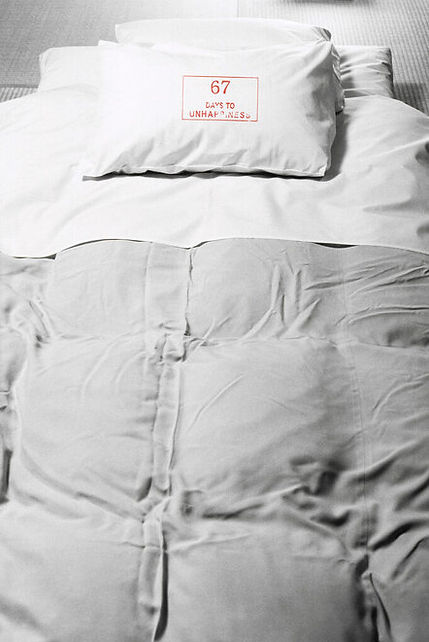
Exquisite Pain (Count Down - 67)", Sophie Calle.
Despite Modern Architectureʼs emphasis on housing, the domestic realm (its interiority, experience and occupancy) is often a neglected area of study since attention is focused on housing as a large-scale urban form. Furthermore, domesticity revolves around the detailed and the routine, and thus, appears in opposition to the monumental scale and specialized function of public spaces.
Yet, domestic spaces embed important issues of gender, class, taste, ethnicity, and also shape notions of individuality, the self as well as determining social relations affiliated with family and community.
As such, artists and filmmakers recognize the domestic realm as an experimental space where new ideologies, practices and objects thrive. This is evident in the numerous house projects by architects like Eileen Gray (E.1027), Charles and Ray Eames (Case study House no.8), Robert Venturi (Mother’s House), Atelier Bow Wow (Tower House) and Ma Qingyun (Father’s House) for example, where issues related to technology, class, gender, politics, the family and the city are played out. Filmmakers such as Alfred Hitchcock (Rear Window), Wong Kar Wai (Chungking Express), and Eric Khoo (12 Storeys) explore the voyeuristic tendencies of urban apartment living while Tan Pin Pin (Moving House) reframe the Asian notions of 'home' and 'ground' in relation to cultural and global tensions. Artists like Judy Chicago (The Dinner Party), Simryn Gill (Dalam), Do-Ho Suh (348 West 22nd St), Matthew Ngui (Home Project) Rachel Whiteread (House), and Martha Rosler (Semiotics of the Kitchen) investigate home as a space fraught with unseen risks, emotions and biases. This interdisciplinary elective explores the concept of domesticity – how and where we live – by examining its portrayals in three related visual disciplines, that is, architecture, art and film. It gives a broad and critical overview by working through a series of key contemporary architectural, art and film projects drawn from Asia, Europe and the United States. The elective also examines how domesticity is ultimately related to cultural, social, economic and political contexts.
Weekly seminars will focus on discourse and practice by discussing key theories and projects revolving around the subject of the domestic realm.
The elective will enrich the studentsʼ conceptual understanding of ʻdomesticityʼ and ʻhomeʼ, by supplementing knowledge from architectural history and theory, with methodological approaches from psychoanalysis, anthropology, philosophy and sociology. The elective is structured to give students an overview of domesticity in Western as well as Asian contexts, thus providing critical tools to analyze and compare differences and similarities in these two situations. It also aims to develop knowledge on domestic concepts in the contemporary Asian context.
[ RESEARCH PROJECT ]
bottom of page